
EM 385 24-Hour Fall Protection Competent Person Training | On-Site USACE Training
Our instructor-led EM 385 24-Hour Fall Protection Competent Person Training is conducted at your facility anywhere in the United States for groups of eight or more participants.
Designed for contractors performing work on U.S. Army Corps of Engineers (USACE) projects and other federal construction sites, this course prepares designated Competent Persons to recognize fall hazards, evaluate jobsite conditions, select appropriate fall protection systems, supervise elevated work activities, and fulfill the responsibilities outlined in EM 385-1-1 Section 21.C.04.
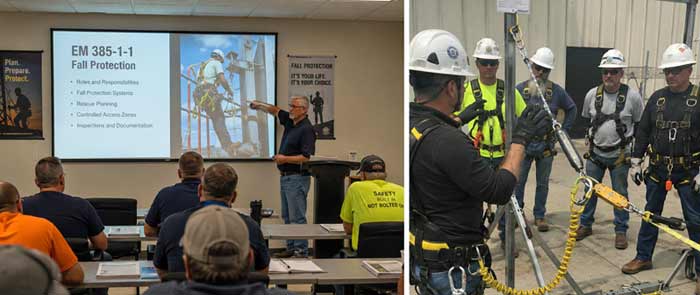
Unlike many generic fall protection classes, this course combines detailed classroom instruction with practical applications using your company’s equipment and work environment whenever possible.
Ready to Schedule EM 385 Fall Protection Training?
Who Should Attend
This course is designed for personnel who may be designated as a Competent Person for fall protection activities, including:
- Construction superintendents
- Site supervisors
- Foremen
- Safety managers
- Project managers
- Competent Persons
- Scaffold supervisors
- Aerial lift supervisors
- Maintenance supervisors
- Personnel responsible for implementing fall protection programs
How Is This Different from the OSHA Fall Protection Training We Have Already Received?
This is one of the most common questions we receive.
While OSHA fall protection training is an important foundation for worker safety, it generally does not satisfy the EM 385 training expectations for a designated Competent Person on U.S. Army Corps of Engineers projects.
OSHA standards primarily teach workers how to recognize fall hazards and properly use fall protection equipment.
The EM 385 Competent Person course goes much further.
It prepares designated individuals to evaluate hazards, make safety decisions, inspect fall protection systems, supervise work activities, implement site-specific fall protection procedures, and take immediate corrective action when unsafe conditions exist.
OSHA Fall Protection Training Typically Covers
- Basic fall hazard recognition
- Employee responsibilities
- Proper use of personal fall arrest systems
- Equipment inspection basics
- OSHA regulatory requirements
EM 385 Competent Person Training Also Includes
- Evaluating complex fall hazards
- Selecting appropriate fall protection systems
- Inspecting fall protection equipment
- Evaluating anchorage points
- Developing fall protection programs
- Establishing controlled access zones
- Supervising elevated work
- Rescue planning
- Correcting hazardous conditions
- Authority to stop unsafe work
Serving as a Competent Person involves much more than understanding regulations—it requires the knowledge, experience, and authority to protect workers before an incident occurs.
Ready to schedule training for your team?
On-Site Training at Your Facility
Training is conducted at your facility or jobsite anywhere in the United States for groups of eight or more participants. Conducting the course at your location allows instruction to be customized to your actual work environment, equipment, and jobsite hazards. This often results in greater employee participation and better retention than training held off-site.
Hands-On Training Using Your Equipment
Whenever practical, hands-on exercises are conducted using your company’s own fall protection equipment. Students gain experience inspecting and evaluating the same equipment they use every day.
Practical activities may include:
- Harness inspection
- Proper harness adjustment
- Anchorage evaluation
- Connector compatibility
- Self-retracting lifelines
- Horizontal lifeline considerations
- Ladder safety
- Scaffold fall protection
- Aerial lift fall protection
- Warning line systems
- Hazard recognition exercises
- Rescue planning discussions
Using your own equipment helps bridge the gap between classroom instruction and real-world application.
Lessons Learned from Real Fall Accident Investigations
Unlike many training providers, this course draws upon years of occupational safety experience and fall-related accident investigations and expert witness cases. Throughout the class, students learn not only what the regulations require, but also why workers continue to suffer serious injuries and fatalities from falls. Real-world case examples are incorporated throughout the training to help participants recognize hazards before an accident occurs.
Topics frequently discussed include:
- Inadequate planning
- Improper anchor selection
- Failure to inspect equipment
- Swing fall hazards
- Poor supervision
- Lack of rescue planning
- Equipment misuse
- Communication failures between contractors
These lessons help participants understand the practical application of EM 385 requirements—not just memorize the regulations.
Topics Covered During the Course
EM 385 Fall Protection Requirements
Understanding how EM 385 applies to government construction projects and the responsibilities of designated Competent Persons.
Roles and Responsibilities of the Competent Person
Authority, hazard recognition, inspections, documentation, and corrective actions.
Fall Protection Program Development
Creating and implementing effective site-specific fall protection programs.
Controlled Access Zones
Establishing and managing controlled access zones in accordance with EM 385.
Fall Protection Systems
Selection, inspection, use, and limitations of various fall protection systems.
Covers and Floor Opening Protection
Requirements for protecting holes, roof openings, skylights, and walking-working surfaces.
Safety Net Systems
Design requirements, inspections, installation, testing, and limitations.
Personal Fall Protection Equipment
Harnesses, lanyards, connectors, self-retracting lifelines, anchorages, compatibility, inspection, storage, swing fall hazards, and fall clearance.
Ladder-Climbing Devices
Fixed ladders, ladder safety systems, climbing procedures, and vertical access.
Scaffolds, Elevated Work Platforms and Aerial Lifts
Fall protection requirements for commonly used elevated work equipment.
Warning Line Systems
Proper installation, use, and limitations.
Safety Monitoring Systems
When permitted, responsibilities of the monitor, and system limitations.
Rescue Planning
Developing practical rescue procedures before work begins.
Working Over or Near Water
EM 385 requirements involving personal flotation devices and fall protection.
Engineered Fall Protection Systems
Horizontal lifelines, engineered anchors, specialized systems, and Qualified Person involvement.
Common Mistakes Competent Persons Are Trained to Watch For
During the course, we discuss some of the most common fall protection mistakes observed on construction projects, including:
- Assuming every structural member is a suitable anchorage.
- Failing to calculate total fall clearance.
- Overlooking swing fall hazards.
- Using incompatible connectors.
- Leaving damaged equipment in service.
- Beginning work without an effective rescue plan.
- Assuming yesterday’s inspection is sufficient for today’s work.
- Allowing changing jobsite conditions to create new hazards.
Recognizing these issues before work begins can prevent serious injuries and OSHA citations.
Student Certification
Participants who successfully complete the course receive documentation of training that includes:
- Student name
- Course title
- Date(s) of training
- Number of training hours
- Instructor information
- Verification of classroom instruction and practical applications
Training records should be maintained by the employer as part of the organization’s overall fall protection program.
Participants are also informed of the EM 385 annual refresher expectation for designated Competent Persons.
Frequently Asked Questions
Does OSHA 30 satisfy EM 385 Competent Person training?
No. OSHA 30 and EM 385 Competent Person training serve different purposes. OSHA 30 provides a broad understanding of OSHA requirements, while this course prepares designated Competent Persons to fulfill the responsibilities outlined in EM 385.
Is hands-on training included?
Yes. Whenever practical, students work with your company’s own equipment during practical exercises.
Where is the training conducted?
Training is conducted at your facility or jobsite anywhere in the United States.
How many employees are required?
A minimum of eight participants is generally required for on-site training.
Will participants receive certificates?
Yes. Students who successfully complete the course receive documentation of training completion.
Can the course be customized?
Yes. Practical exercises and discussions can be tailored to your company’s equipment, work activities, and typical fall hazards.
How often should Competent Persons receive refresher training?
EM 385 recommends that Competent Persons remain current in fall protection and rescue knowledge by participating in at least two hours of annual refresher training or informational meetings.
Schedule EM 385 Competent Person Training
Protect your employees. Meet EM 385 requirements. Build confidence in the individuals responsible for supervising work at heights.
Whether your organization is preparing for an upcoming USACE project or strengthening an existing fall protection program, we can provide experienced, practical, and engaging on-site instruction tailored to your operations.