
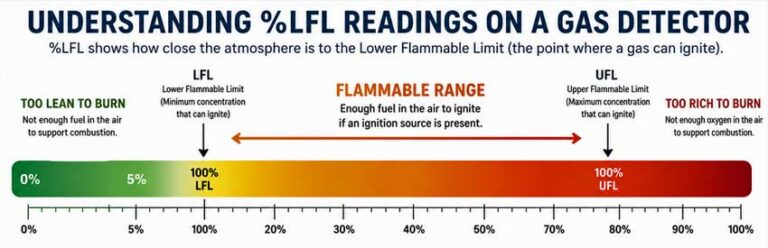
If you’ve ever used a gas detector equipped with a flammable gas sensor in or around a confined space, you’ve probably seen readings displayed as %LFL. It’s a familiar number, but for a lot of people, it’s not entirely clear what that number is really telling you.
That matters, because reading it correctly can make the difference between recognizing a developing hazard and missing it after its too late.
So, let’s walk through what %LFL actually means and how to interpret it in a way that’s useful in the field.
What %LFL Is Really Measuring
LFL stands for Lower Flammable Limit. It’s the minimum concentration of a particular airborne gas that can ignite in the presence of an ignition source. So, when your gas detector shows %LFL, it’s not telling you the exact amount of gas in the air. Instead, it’s telling you how close the atmosphere is to the point where the flammable gas could ignite.
When your detector reads 100% LFL, it means the atmosphere has reached that ignition threshold. At that point, if there’s a spark or flame, conditions are right for a fire or explosion.
Most of the time, though, you’re looking at numbers well below that; 5%, 10%, maybe even 100% LFL. Those numbers are easy to misinterpret if you don’t know what they represent.
Avoid This Common Misunderstanding
A reading of 10% LFL does not mean 10% gas in the air. It means you’re at 10% of the concentration of gas required to reach the flammable limit. That’s a big difference.
Think of it this way: %LFL is more like a “distance-to-danger” indicator than a direct measurement of gas concentration. As the number increases, you’re moving closer to conditions where ignition is possible.
A Simple Example
Take methane gas, which is commonly encountered in confined spaces. Methane has an LFL of about 5% by volume. That means methane must make up at least 5% of the total atmosphere to reach the point where it can ignite.
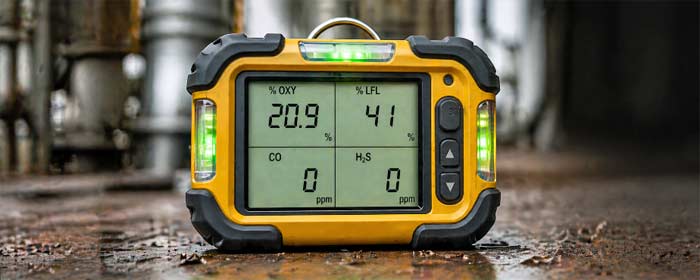
So as an example; if your detector shows 41% LFL (see image below), you’re not looking at an atmosphere made up of 41% methane. Instead, it means you’re looking at 41% of that 5% threshold for methane. Or, in in other words, about 2.05% of the total atmosphere is made up of methane.
That being said, there is a very good reason not to confuse %LFL with actual gas concentration. And that reason is the OSHA definition of a hazardous atmosphere in their confined space standards.
OSHA Definition of LFL Explained
According to OSHA, the atmosphere inside a confined space is considered hazardous, and the confined space becomes permit-required, when flammable gas levels inside the space exceed just 10% of the LFL. That can catch people off guard, because it’s well below the point where the gas can actually ignite.
But what you must realize is that the goal of the OSHA threshold for a hazardous atmosphere isn’t to wait until you’re in the flammable range before you act – – it’s to prevent you from ever getting close to it before proper precautions are implemented.
This is because atmospheric conditions inside confined spaces can change, sometimes quickly. Gases can be released from previously undisturbed materials, evaporation rates of flammable liquids can increase along with rising temperatures, and work activities such as spray application of flammable coatings can release flammable mists and vapors into the air.
Because of reasons such as these, %LFL should always be thought of as a snapshot in time, not a permanent condition. Therefore, it is a good idea to conduct continuous atmospheric monitoring inside of confined spaces when there is a potential for any type of hazardous atmosphere.
Why This Isn’t Just a Technical Detail
It’s easy to treat %LFL as just another number on the screen, but it directly influences real decisions; whether a space is safe to enter, whether work can continue, or whether conditions are starting to move in the wrong direction.
Misunderstanding it can lead to entering a hazardous atmosphere, increasing the risk of fire or explosion, and exposing both workers and employers to serious consequences. For anyone involved in confined space entry, this is one of those fundamentals that needs to be clearly understood, and not just recognized.
Watch Video: %LFL Explained in Plain Terms
If you’d like to see this topic explained visually, including how LFL and UFL relate to each other and how these readings apply in real-world confined spaces, the video below, created using content from our online confined space training courses, walks through it step by step.
Where to Get Confined Space Training
If you or your team are responsible for confined space entry, proper training makes a real difference. And we offer professional comprehensive training both online and an site (see buttons below):
Our confined space training includes a section on how to properly monitor the air inside of a confined space, but also how to interpret gas detector readings, recognize atmospheric hazards, and apply OSHA requirements in real-world situations.
On Site Confined Spaces for General Industry Training Class
Expert trainer comes to your location to conduct general industry confined space training for your group of 8 or more trainees
On Site Confined Spaces in Construction Industry Training Class
Expert trainer comes to your location to conduct confined space training for the construction industry for your group of 8 or more trainees
Online Confined Space Training Course - General Industry
On demand confined space training courses for general industry (1910.146). Start immediately, log in/out, print cert upon completion
Online Confined Spaces Training Courses for Construction Industry
On demand confined space training courses for the construction industry (1926 Subpart AA). Start now, log in/out at will, print cert upon completion

