
If you have heard that OSHA updated the Hazard Communication Standard (HazCom) in 2024, you are probably wondering what that means for your business. Do you need to retrain everyone? Update labels? Replace SDSs?
For most employers, the answer is much simpler and less disruptive than it might sound.
This blog post explains what changed, what did not change, when additional employee training is actually required, and what the recently extended 2026 training deadline means.
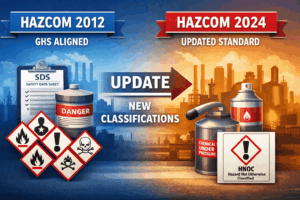
OSHA Hazard Communication Standard Updates: 2012 vs. 2024
To understand the 2024 update, it helps to put it in context.
The 2012 HazCom update was a major overhaul. OSHA aligned the standard with the Globally Harmonized System (GHS), introducing:
- Pictograms
- Standardized label elements
- The 16-section Safety Data Sheet (SDS) format
Most employers remember this update because it fundamentally changed how chemical hazards were communicated.
The 2024 update, by comparison, is much narrower. It aligns OSHA’s standard with a newer version of GHS, but it does not reinvent the hazard communication system.
What Did NOT Change in the 2024 HazCom Update
Let’s clear up one of the biggest misconceptions first.
The 2024 update did not:
- Add new types of label elements
- Add new pictograms
- Change the SDS format
- Require retraining employees on how to read labels or SDSs
If your employees were trained after the 2012 update, they already understand:
- Product identifiers
- Signal words
- Hazard statements
- Precautionary statements
- Pictograms
- How to use an SDS
All of that still applies, no additional training is required on these.
What DID Change in the OSHA HazCom 2024 Rule
The 2024 update focuses on how certain hazards are classified, not on changing how hazards are communicated.
OSHA adopted updated GHS classification criteria for specific hazards, including:
- Flammable gases (revised categories)
- Aerosols
- Chemicals under pressure
- Certain physical and health hazard classifications
Because of these changes, some chemicals may now be classified differently than before, even though the product itself has not changed. That distinction is critical for employers.
For example, certain compressed gases like nitrogen or argon in cylinders may now be classified as chemicals under pressure. Employees who weren’t previously educated on that hazard classification require additional training.
Another example involves some industrial cleaning solvents. Products once classified as skin irritants may now be classified as skin corrosives. Employees using these products must be retrained on the updated classification.
When Employee Training Is Required Under the 2024 HazCom Update
Here is the most important compliance takeaway:
Additional training is required only when employees are exposed to new or different hazard information.
Training is triggered by changed hazards, not by the existence of a new OSHA rule.
Examples of when training is required:
- A chemical now has a new hazard classification
- A product label includes a new pictogram or hazard statement
- An SDS identifies hazards employees were not previously trained on
Examples of when training is not required:
- Employees already understand labels and SDSs
- No hazard classifications for chemicals in your workplace have changed
- The update only affects manufacturers or distributors, not end users
This is targeted training, not blanket retraining.
2026 HazCom Training Deadline: Who Needs It
OSHA has extended its compliance deadline of 2026 for training employees on updated hazard classifications.
- This does not apply to every workplace or worker.
- It only affects employees who handle chemicals that are newly classified or have revised hazard information under the 2024 rule.
- According to OSHA’s extended compliance deadlines, employers must provide training for affected employees by no later than November 20, 2026 for newly classified substances, and by May 19, 2028 for mixtures containing these substances.
For most employers, this means only a small subset of employees, if any, will need additional training, not your entire workforce.
Label and Pictogram Changes Explained, Including HNOCs
Some employers have heard that label requirements or pictograms changed in 2024, particularly regarding the exclamation mark pictogram and Hazards Not Otherwise Classified (HNOCs).
Here is what actually happened:
- The exclamation mark pictogram is not new
- OSHA had already allowed its use for certain HNOC hazards through guidance
- The 2024 update formalized that allowance in the regulatory text
For employees, this does not introduce a new symbol or concept. It just means that some hazards may now appear more clearly or consistently on labels.
Again, the training impact is about how labels apply to specific chemicals, not learning a new labeling system.
Do Employers Need to Retrain All Employees on HazCom?
For most employers, the answer is no.
You do not need to:
- Redo full Hazard Communication training
- Re-explain pictograms employees already understand
- Conduct training simply because OSHA issued an update
You do need to:
- Review updated SDSs as they are received
- Identify chemicals that now have revised hazard classifications
- Provide focused training to employees who handle these chemicals before the 2026 deadline
This approach is fully consistent with long-standing HazCom training requirements.
OSHA HazCom 2024 Update: Bottom Line for Employers
The 2024 Hazard Communication update means:
- The communication system stays the same
- Labels and SDSs work the same way
- Pictograms did not change
- Some hazard classifications may be different
- A small subset of employees may need training by 2026
Employers should focus on whether the chemicals they use now carry different hazard information, not on the fact that OSHA updated the rule.
If you already have a solid Hazard Communication program, this update is more about review, verification, and targeted training than rebuilding your program from scratch.
Online Hazard Communication Training Courses – Pick the Course Right for You
Now is the perfect time to make sure each one of your employees is properly trained, or retrained, on the OSHA Hazard Communication standard. Select the online course that fits your workplace needs:
Each course is designed for easy online completion, covering labels, SDSs, pictograms, and updated hazard classifications so your employees stay safe and compliant. Download a personalized HazCom training certification upon completion of the course for proof of compliance.

